
Utica students present research and lead workshops at regional and national Computer Science conferences

"It’s really valuable because students learn to connect what they do in class with real-world expectations, and they build confidence in presenting and communicating their ideas."
It was a busy April for Utica University students involved in Computer Science, taking part in two notable conferences in the northeast where they presented their research, led workshops, and took home some honors in the process.
Dr. Unnati Shah regularly attends the Consortium for Computing Sciences in Colleges-Northeastern Region (CCSCNE) with students, bringing ten participants from Utica University to this year’s event, held at Smith College in Northampton, Massachusetts.
Originating in 1996, CCSCNE is one of the largest regions of the Consortium for Computing Sciences in Colleges (CCSC), bringing together faculty, staff, and students from academic institutions throughout the Northeast for exchange of ideas and information concerning undergraduate computing curricula. The conference provides a regional forum for the exchange of information and ideas pertaining to the concerns of computing and computing curricula in a smaller academic environment. The proceedings of the conference are published as an issue of the Journal of Computing Sciences in Colleges.
Participating Utica students included Computer Science majors Alexander Gomez, Vonnie Magnusen, Connor Pirkl, Alan Catic, and Makayla Coleman, Mathematics majors Gavin Magill and Ju Mi La, Cybersecurity majors Patrick Penna and Colin Zouck, and Computer Science & Cybersecurity dual major Nathaniel Illingsworth.
The event brought together programming contests, paper presentations, and poster sessions, featuring two research papers and four posters that highlighted strong technical depth and applied innovation.
Student participants included Projects covered diverse areas such as:
- Patrick Penna and Connor Pirkl – “Sustainable Networking: Energy-Efficient Routing for a Greener Internet”
- Alexander Gomez and Nathanial Illingsworth – “Smart Traffic Routing Using AI and Software-Defined Networking”
- Alan Catic and Colin Zouck – “Personalized Interactive Calendar Program”
- Vonnie Magnusen and Patrick Penna – “VulneraX: Drift-Aware Time-Series Forecasting for Software Vulnerability Risks”
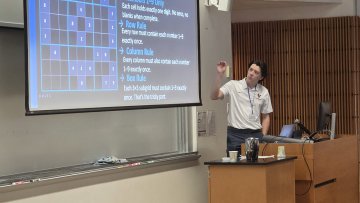
Colin Zouck, a Cybersecurity major with a minor in Computer Science presented “Apache Sudoku: A Web-Based Game for Learning and Demonstrating Web Development Concepts,” a Demo & Applied Computing paper, at CCSCNE 2026. The work, developed under the guidance of Dr. Unnati Shah, was also published in ACM, marking an important academic achievement and recognition of his contribution to applied web development education.
What began as classroom curiosity about how websites function gradually evolved into a hands-on opportunity to explore web development in a deeper way. Through CSC 325 – Programming Languages, Zouck was introduced to core technologies such as HTML, CSS, and JavaScript, but he became especially interested in how these individual components come together to form a complete, interactive system. That curiosity became the foundation for Apache Sudoku, a web-based game designed to connect learning with practical implementation.
Rather than viewing web development as separate concepts, he focused on understanding the relationships between structure, logic, and user interaction. This perspective led him to build a fully interactive Sudoku game that runs in a browser and responds dynamically to user input, strengthening his understanding of system design, problem-solving, and applied programming concepts.
Through CSC 325 under the mentorship of Dr. Shah, Colin was able to transform academic learning into a functional project that bridges theory and practice. His work reflects steady growth from curiosity-driven learning to published academic contribution, demonstrating how classroom exploration can evolve into meaningful research and real-world application. Apache Sudoku represents Colin’s journey from curiosity to publication, highlighting his development as a student who not only learns concepts but applies them to create impactful and educational software.
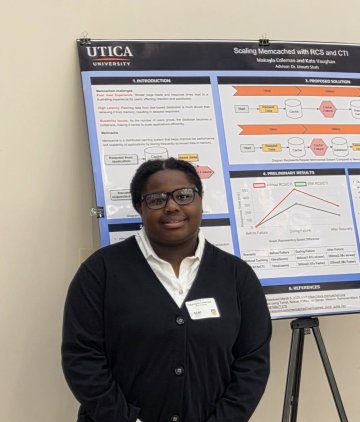
Also presenting at CCSCNE 2026 was Makayla Coleman on “ConnectPlus: A Full-Stack Collaboration Tool for Academic and Team Projects.”
What started as a structured course project quickly grew into a comprehensive full-stack application designed to solve real challenges in team collaboration. Built using the MERN stack, ConnectPlus integrates key features such as authentication, dashboards, task management, alerts, and messaging into a unified platform. The project reflects her dedication to mastering full-stack development while strengthening her understanding of system design, backend architecture, and real-world application development.
Building on this foundation, Coleman further expanded her academic work by presenting at CCSCNE 2026, where her applied computing tool paper highlighted both the technical depth and practical relevance of ConnectPlus. The paper showcased not only the system’s architecture and functionality but also its value as a learning tool for collaborative software development. This milestone marked her transition from classroom-based learning to contributing to broader academic and professional discussions in computing.
Coleman was also one of three students from Utica to take part in the ACM New York Celebration of Women in Computing.
Promoting the academic, social, and professional growth of technical women and their allies throughout New York State, the ACM New York Celebration of Women in Computing was held in Albany with a trio of students from Utica University taking part to showcase their research and work to a national audience of attendees.
The ACM New York Celebration of Women in Computing (NYCWiC) is a regional conference dedicated to empowering women and their allies in computing, serving as a vital platform for networking, learning, and celebrating the contributions of women in technology.
The mission of NYCWiC is to promote the academic, social, and professional growth of technical women in the state of New York, with a goal to encourage women to complete their studies in computing by exploring careers and meeting women leaders from business, industry, and academia.
Each contribution reflected a different dimension of computing ranging from communication in data science, to industrial applications of data-driven quality assurance, to hands-on full-stack development learning.
“As a mentor, I feel truly proud working with these students and seeing them progressively grow, build confidence, and take ownership of their work,” explained Dr. Unnati Shah, Associate Professor of Computer Science at Utica University. “It is incredibly rewarding and deeply fulfilling to see students you have mentored grow into confident presenters, educators, and problem-solvers at a competitive national conference like NYCWiC.”
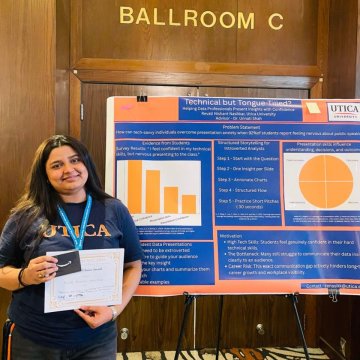
MBA in Business Analytics Graduate Student Revati Nasikkar was awarded Best Poster for “Technical but Tongue-Tied? Helping Data Professionals Present Insights with Confidence,” mentored by Dr. Shah. This recognition, voted by conference attendees, highlights both the strength of her research and the clarity and impact of her presentation.
Revati’s research focuses on bridging the gap between strong technical skills and weak presentation confidence in data professionals. Based on survey findings, she identified that while students feel confident in analysis, they often struggle to communicate insights effectively. To address this, she developed a structured storytelling framework that guides presenters to start with a clear question, present one insight per slide, use annotated visuals, and follow a simple narrative flow supported by short timed practice pitches. Her work is grounded in data storytelling principles and aims to make complex ideas easier to communicate and understand.
“Watching Revati receive the Best Poster recognition, voted by conference attendees, was especially meaningful because it reflects not only the strength of her work but also her ability to connect with and impact an audience.”
Makayla Coleman, a Computer Science major, led a workshop titled “From Zero to Full-Stack: Build Your First Web App in 60 Minutes.” The session delivered a highly engaging, hands-on learning experience focused on full-stack web development through a hands-on workshop, where she built complete applications using React, Node.js, and MongoDB in StackBlitz. She emphasized how frontend, backend, and databases connect through APIs and strengthened participants’ understanding of core JavaScript concepts.
“Makayla’s journey stands out in a very personal way. I still remember a day I attended NYCWiC with Makayla in 2023. At that time, I told her that one day she would be presenting at this conference. This year, that moment came full circle. Not only did she present, but she also confidently led a workshop and created a meaningful learning experience for others.”
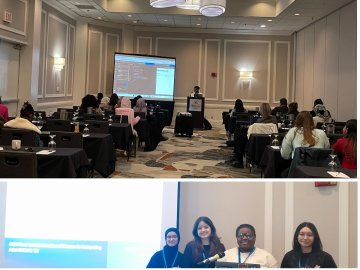
Collecting feedback from attendees, one response that stood out to Dr. Shah was: “It was interactive and I enjoyed learning about JavaScript.”
“In today’s AI-driven era, Makayla’s workshop also carried an important message to other women in computing, that while tools and technologies continue to evolve, a strong understanding of core fundamentals remains essential. She not only delivered technical learning but also demonstrated leadership by guiding others through that realization in a very accessible and engaging way. As a mentor, I feel immensely proud seeing her growth, confidence, and ownership of her work. It is one of those rare moments that truly reminds me why mentorship matters.”
MBA in Business Analytics Graduate student Karamjit Kaur presented a poster on “Data-Driven Quality Assurance for Defect Tracking in Semiconductor Manufacturing,” focused on defect analysis using trend and Pareto analysis to identify recurring issues and the most frequent defect types.
“Her work highlighted improved visibility of defect trends, faster identification of recurring defects, and stronger data-driven decision-making in quality assurance. She also incorporated statistical evaluation and root cause analysis to better understand defect distribution and reduce manufacturing errors, presenting the work with clear structure and strong applied relevance.”
All participants actively engaged in building their first web application, gaining practical experience, confidence, and a strong understanding of foundational web development skills. The workshop effectively bridged theory with practice, making complex concepts accessible through interactive learning.
Dr. Shah has been attending NYCWiC with students every year since she joined Utica University. This year she also serves as a budget chair for the conference.
“We participate regularly because it gives students a great opportunity to present their work, get feedback, and interact with both academics and industry professionals, including people from companies like IBM, Broadcom, and Blizzard. From a mentoring perspective, it’s really valuable because students learn to connect what they do in class with real-world expectations, and they build confidence in presenting and communicating their ideas. Over time, I’ve seen it play a big role in helping them grow both technically and professionally.”
More Stories

Stronger Together – Unity Walk 2026
Putting feet to pavement amid the golden rays and the autumn colors as rich and multiple as the backgrounds and...

The Perfect Combination of Crime and Chemistry: Brayden McCaw ’27
Who did it? Where? And with what? It’s not a game of Clue that’s afoot – but a murderous simulation...

PioTalk opens conversation about sexual assault, violence, and building safer communities
On October 8, Utica University hosted a PioTalk discussion titled “The Cornell Case and the National Conversation on Sexual Violence”...
I would like to see logins and resources for:
For a general list of frequently used logins, you can also visit our logins page.